For many, transformation is no longer a single programme with a neat beginning, middle, and end. It is a stack of overlapping shifts: restructuring, new systems, AI adoption, leadership change, workplace redesign, cost pressure, and changing employee expectations.
That is often where programmes begin to struggle.
Not because the strategy is weak. Not because the governance is poor. But because the organisation is having to absorb change faster than leaders realise.
This is the ‘Change Readiness Gap’: the point at which a programme is moving at one speed, while employee understanding, manager confidence, leadership alignment, and day-to-day adoption are moving at another.
On paper, everything may look in motion. In practice, the people side of the transformation is falling behind.
For transformation directors, change leaders, and communications directors, this gap matters because it often explains why a programme that seems well planned still feels harder to land than expected. Messages are going out. Milestones are being hit. Yet confusion, hesitation, resistance, or inconsistency remain stubbornly present.
In our experience at Blue Goose, this is often where communication becomes the difference between change that is merely announced and change that is actually understood, trusted, and acted on. Below are seven signs to look out for to determine if your change programme is is going to be successful:
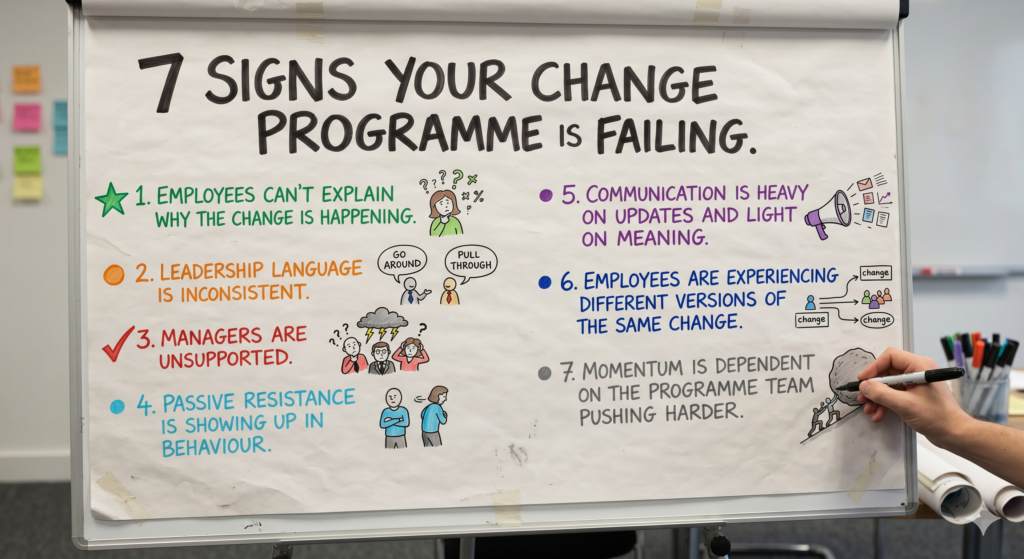
1. Employees can repeat the update, but not explain the point of the change
A common trap in transformation is mistaking message distribution for understanding.
Employees may have seen the intranet post, attended the town hall, or heard the leadership update. But if they still cannot explain why the change is happening, what problem it is solving, or what success looks like, the message has not landed in a meaningful way.
Communication needs to do more than circulate information. It needs to create understanding.
2. Leaders are supportive in principle, but inconsistent in language
In large organisations, employees quickly notice when senior leaders are not framing the same change in the same way.
One leader talks about efficiency, another talks about culture, another talks about technology, and another focuses on cost. Each point may be valid, but if the language is not aligned, the overall message begins to feel uncertain.
While of course there may be different lines of responsibility according to roles, there must be congruence in the messaging that unites all. Any inconsistency weakens trust. It can also create unnecessary room for rumour, scepticism, or selective interpretation.
3. Managers are being asked to translate the change without enough support
Managers are often the most important communication layer in any transformation.
They are the people employees turn to when they want the real meaning of the change, not just the official update. If managers are unclear, overloaded, unconvinced, or under-equipped, the change slows at team level.
This is one of the most under-estimated risks in large programmes. Leaders may believe communication has been cascaded, while managers feel they have simply been handed the burden of interpretation.
A sense of burden can also impact the emotional energy needed to support change as highlighted by the CEO of FareShare at our Blue Goose Briefing event.
Kris Gibbon-Walsh said: People are human beings and we talk about people’s energy in an organisation being the single most important resource. The more change you go through, the less energy you have in the organisation. So, you have to think about what recovery looks like for your people and what your peloton is within your organisation.
4. Passive resistance is showing up in behaviour
The greatest risks are not always loud.
Sometimes resistance looks like delayed actions, quiet disengagement, low ownership, poor attendance, minimal effort, or people reverting to old habits after the initial launch. In repeated cycles of change, this kind of passive resistance can become normalised.
That is why behavioural signals matter so much. They often tell a truer story than formal programme updates.
5. Communication is heavy on updates and light on meaning
Many programmes respond to complexity with more communication volume.
More emails. More briefings. More slide decks. More updates.
But high volume does not guarantee clarity. In fact, it can have the opposite effect if communication is focused on announcements rather than interpretation.
People do not just need to know what is happening. They need help making sense of what it means for them, their teams, and the wider direction of the organisation.
6. Different audiences are experiencing different versions of the same change
In enterprise organisations, transformation is never experienced evenly.
A frontline employee, a regional manager, a functional lead, and a senior executive may all be living through the same programme in very different ways. Different channel access, different operational pressures, and different levels of visibility all shape that experience.
If communication is too generic, those gaps widen. People begin filling in the blanks for themselves, and different versions of the same change start to emerge.
7. Momentum depends on the programme team pushing harder
When understanding and ownership are weak, programme teams often compensate by increasing pressure.
More urgency. More reminders. More meetings. More escalation.
Sometimes this creates short-term movement. But it rarely creates durable buy-in. If momentum depends entirely on the centre pushing harder, the organisation may not be truly absorbing the change.
So, what does good look like?
A strong transformation communication approach helps close the readiness gap by doing four things well.
First, it creates a clear narrative around the ‘why, what, and how’ of change. People need a credible reason for the transformation, a realistic picture of what it means, and a sense of how they can move with it.
Second, it aligns leaders around shared language and visible priorities. Consistency at leadership level does not remove uncertainty entirely, but it makes change feel more coherent and more trustworthy.
Third, it equips managers to communicate with confidence. They need more than a few slides and a cascade instruction. They need practical support that helps them answer questions, interpret the change locally, and lead their teams through it.
Fourth, it helps employees understand what the change means in practical terms. That means moving beyond abstract announcements and into useful explanation, relevant examples, and communication that reflects how different audiences actually experience change.
This is where specialist communication support can make a real difference. Blue Goose has spent years helping large and complex organisations shape change narratives, prepare leaders, create campaigns, and build the communication conditions that make transformation easier to absorb.
The challenge is rarely just to communicate more.
It is to communicate in a way that creates clarity, trust, and forward movement.
Image by Geralt